
What is Conversational AI? (And Why It Matters for Fashion Brands)
Cut through the confusion and learn how conversational AI differs from basic chatbots—and why fashion brands need specialized solutions.
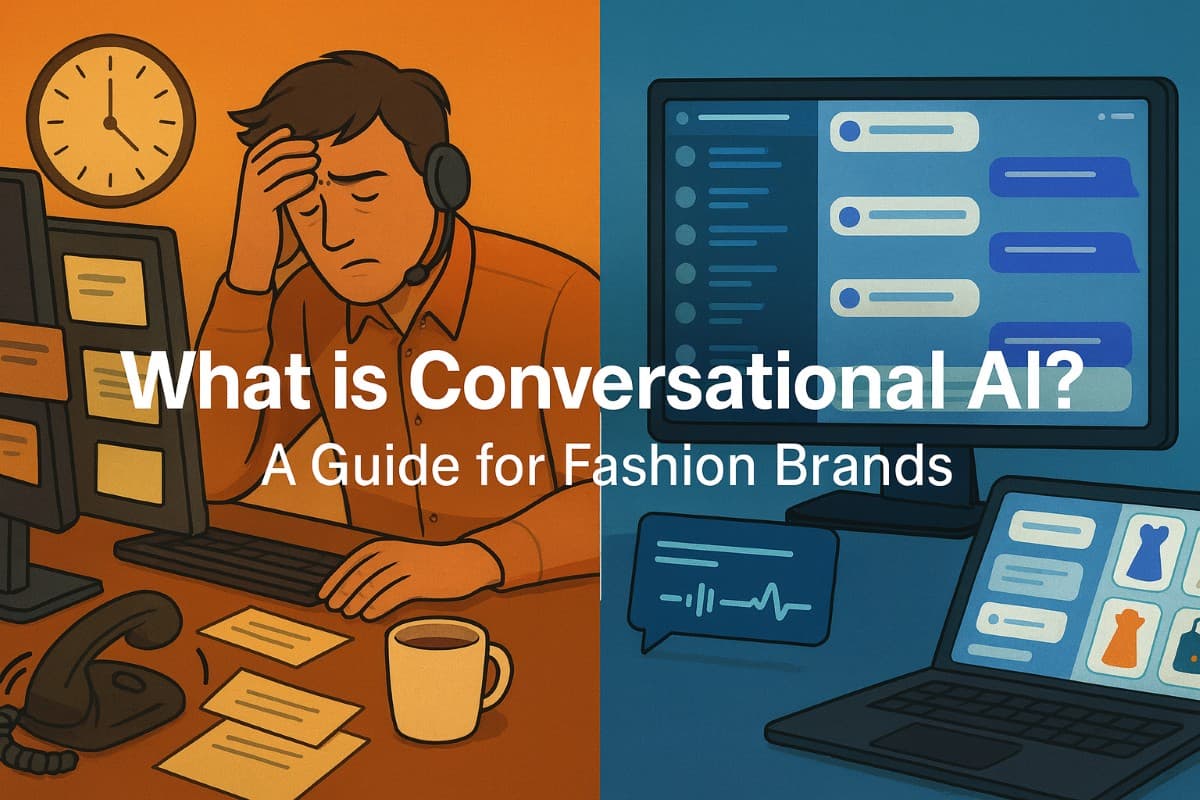
Modern conversational AI understands context and intent, unlike basic chatbots
If your fashion brand's customer service feels overwhelming—with sizing questions flooding your inbox, return rates climbing past 30%, and your team drowning in repetitive questions during peak season—you've probably heard that "AI can help."
But what does that actually mean?
The term "conversational AI" gets thrown around constantly in e-commerce circles. Some people use it interchangeably with "chatbot." Others describe it as something completely different. And if you're like most fashion brand operators, you're wondering: What is conversational AI, really? Is it just another buzzword? And why should I care specifically for my fashion brand?
Let's cut through the confusion.
What is Conversational AI? (The Simple Explanation)
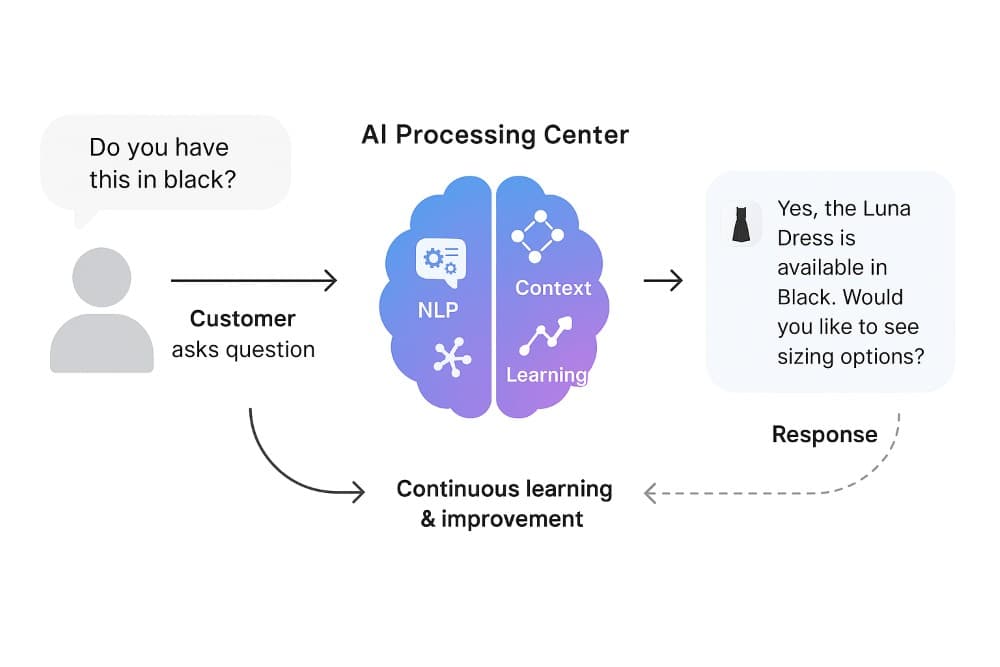
Conversational AI combines natural language processing, machine learning, and context management
Conversational AI is technology that lets customers have natural, back-and-forth conversations with your brand—whether they're typing in a chat window or speaking out loud—and it actually understands what they mean, remembers the context of the conversation, and responds in a way that sounds like your brand.
Think of it as the difference between pressing buttons on a phone tree (frustrating, rigid) and talking to a helpful human assistant (natural, flexible). Conversational AI aims for the second experience.
Behind the scenes, conversational AI uses:
- • Natural Language Processing to understand what customers actually mean
- • Machine learning to get better over time
- • Context management to remember earlier parts of the conversation
- • Multi-turn dialog capabilities to handle complex questions across several exchanges
But you don't need to understand the technical details to benefit from it. What matters is what it does for your business.
The critical thing that makes conversational AI different from older chatbot technology is understanding context and intent. When a customer asks, "Do you have this in black?" a basic chatbot might search for the word "black" and show all black products. Conversational AI understands the customer is asking about a specific product they were just discussing and responds accordingly: "Yes, the Luna Dress is available in black. Would you like to see the sizing options?"
What Makes Conversational AI Different from Basic Chatbots?
If you've tried a chatbot before and it frustrated your customers with robotic responses and dead-ends, you're not alone. Many fashion brands had the same experience with first-generation chatbot technology.
Here's why conversational AI is fundamentally different:
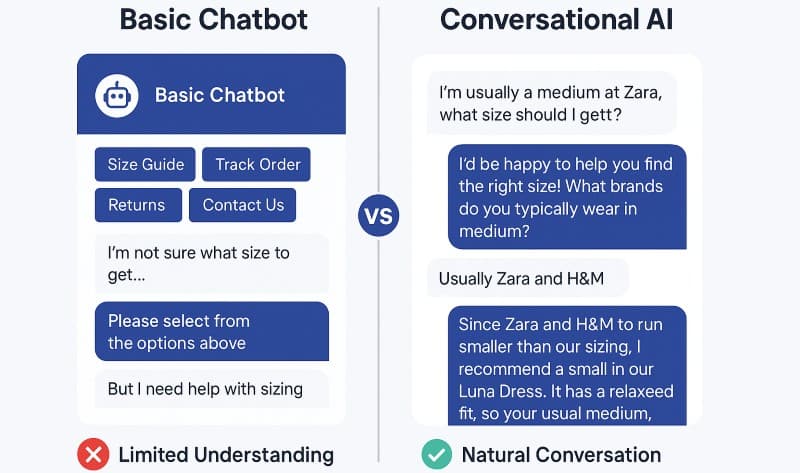
The fundamental differences between scripted chatbots and intelligent conversational AI
| Basic Chatbots | Conversational AI |
|---|---|
| Follow pre-programmed scripts | Understand intent and context |
| Require exact keywords | Handle natural language variations |
| Offer button menus | Understand typed or spoken questions |
| Forget previous messages | Remember conversation history |
| Can't handle unexpected questions | Adapt to various question types |
| Sound robotic | Can match your brand voice |
| One channel only | Work across chat and voice |
| Limited learning | Improve over time with ML |
Real Fashion Brand Example
Let's see this in action with a sizing question—the most common question fashion brands get:
Basic Chatbot:
Customer: "I'm usually a medium, what size should I get?"
Bot: "Please select your size: [S] [M] [L] [XL]"
Customer: "But I'm not sure..."
Bot: "Please select your size: [S] [M] [L] [XL]"
Customer leaves frustrated
Conversational AI:
Customer: "I'm usually a medium, what size should I get?"
AI: "I'd be happy to help! What brands do you typically wear in medium?"
Customer: "Usually Zara and H&M"
AI: "Since Zara and H&M tend to run smaller, I'd recommend trying a small in our Luna Dress. It has a relaxed fit, so the small will give you a similar fit to your usual medium. Would you like me to add it to your cart?"
Customer converts to purchase
Fashion has unique complexity that basic chatbots can't handle: sizing varies by brand and style, fit preferences are subjective, style questions require context, and customers describe products in different ways. Conversational AI can handle these nuances. Basic chatbots can't.
Why Fashion Brands Need Conversational AI
Every e-commerce business can benefit from better customer service. But fashion brands face specific challenges that make conversational AI not just helpful—but essential for staying competitive.
The Sizing Catastrophe
Return rates in fashion e-commerce are significantly higher than other retail categories. According to Coresight Research, the average return rate for online apparel purchases reached 24.4% in 2023, far exceeding the global online average of 16.5%.2,3 Multiple industry sources report that clothing return rates range between 25-40%.1,4 In 2024 alone, total e-commerce returns reached $890 billion.5
Every return costs you shipping fees (both ways), processing and restocking labor, product depreciation, lost margin, and customer disappointment.
By asking the right questions about fit preferences, comparing to brands customers already know, and understanding their style needs, conversational AI can dramatically reduce incorrect purchases. Research shows that 90% of shoppers do not fit apparel as designed, and size confusion is responsible for 35% of abandoned carts and over 50% of returns.12,13
The 24/7 Expectation
Your customers shop at 11 PM on a Saturday. They have questions at 6 AM before work. They need help on holidays. But your customer service team works business hours.
Traditional solution? Hire more people, pay overtime, expand shifts. Expensive and still limited.
AI doesn't sleep, doesn't take breaks, and doesn't need benefits. It handles overnight questions with the same quality as daytime inquiries—at a fraction of the cost. According to Gartner research, conversational AI is projected to reduce contact center agent labor costs by $80 billion by 2026, with one third of enterprises reducing customer service operational costs by 30% through AI-driven self-service by 2028.6,7
The Consistency Problem
You've worked hard to build a distinct brand voice. But when you have 5-10 different customer service reps responding to inquiries, maintaining that voice consistently is nearly impossible.
AI learns your exact brand voice and maintains it perfectly across every interaction. Whether it's the 1st conversation or the 10,000th, customers get the same on-brand experience.15
The Peak Season Crush
Black Friday. Cyber Monday. Holiday shopping season. Your customer inquiries spike 3-5x normal volume. Your team is overwhelmed. Response times balloon. Customer satisfaction drops right when it matters most.
AI scales instantly. 10 conversations or 10,000—the response quality stays the same. No training needed. No seasonal hiring headaches. Studies show that AI customer service can reduce resolution times by up to 87% while handling massive volume increases.16
How Conversational AI Works for Fashion Brands
Fashion e-commerce customer inquiries generally fall into eight categories that conversational AI can handle:
| Conversation Type | Volume | Example Questions |
|---|---|---|
| Sizing & Fit | 35-40% | "What size should I order?" "Will this fit me?" "I'm between sizes..." |
| Order Tracking | 20-25% | "Where is my order?" "When will it arrive?" |
| Returns & Exchanges | 15-20% | "How do I return this?" "Can I exchange for a different size?" |
| Style Advice | 10-15% | "What should I wear with this?" "Is this appropriate for...?" |
| Product Information | 10-15% | "What's this made of?" "Is this machine washable?" |
| Availability | 5-10% | "Do you have this in blue?" "When will you restock?" |
| Shipping | 5-10% | "Do you ship internationally?" "What are the shipping costs?" |
| Account & Loyalty | 5-10% | "How do I use my points?" "When does my discount expire?" |
For each conversation type, conversational AI can understand the question in natural language, pull relevant information from your systems, maintain conversation context if follow-up questions arise, match your brand voice in responses, and escalate to human agents when truly necessary.
Is Conversational AI Actually Working? (The Reality Check)
If you're skeptical, you should be. The technology industry overpromises constantly. But conversational AI has real, measurable results:
Cost Reduction
Gartner research projects that conversational AI will reduce contact center agent labor costs by $80 billion by 2026.6 McKinsey research indicates that applying generative AI to customer care functions could increase productivity at a value ranging from 30-45% of current function costs.10 Industry data shows businesses can achieve up to 25% reduction in customer service costs.16
Operational Efficiency
McKinsey analysis shows that AI-enabled customer service can deliver 40-50% reduction in service interactions and more than 20% reduction in cost-to-serve.9 Organizations implementing AI report up to 70% reduction in call, chat, and email inquiries.18 Gartner predicts that by 2028, agentic AI will autonomously complete 15% of day-to-day customer service decisions.8
Customer Satisfaction
Forrester research found that GenAI significantly improves conversational AI capabilities and customer self-service experiences.14 Studies show that 70-80% of interactions can be handled by self-service channels with high satisfaction rates when AI is properly implemented.9
Fashion-Specific Results
Fashion brands using AI sizing assistance see significant conversion rate improvements.11,13 Industry research indicates that over $300 billion in profits are lost annually by fashion brands due to incorrect sizing.12 83% of sales teams using AI report revenue growth.16
The key phrase: "when properly implemented." Not all AI solutions are created equal, and fashion brands need AI that understands fashion-specific challenges.
Key Takeaways
If you remember nothing else from this article, remember these five things:
- •Conversational AI ≠ Basic Chatbots — Modern conversational AI understands context, intent, and natural language. Basic chatbots follow rigid scripts. They're fundamentally different technologies.
- •Fashion Needs Specialized AI — Generic customer service AI won't understand sizing variations, fit preferences, or style questions. Fashion brands need AI trained specifically for fashion e-commerce.
- •It's About Augmentation, Not Replacement — The goal isn't to eliminate your customer service team. It's to free them from repetitive questions so they can focus on complex issues and relationship-building.
- •The ROI is Real — 30-45% productivity increases, 40-50% reduction in service interactions, 25% cost reduction—these aren't marketing claims. They're documented results from organizations using conversational AI properly.
- •Implementation Quality Matters — The fashion brands seeing these results aren't using out-of-the-box chatbot platforms. They're implementing properly designed conversational AI that understands fashion-specific needs.
Get the Complete Fashion AI Customer Service Playbook
Everything you need to evaluate, implement, and optimize conversational AI for your fashion brand—from sizing recommendations to vendor selection.
What's Inside:
- 8 fashion-specific automations with ROI projections
- DIY vs. Agency decision framework
- Vendor evaluation scorecard (10 essential questions)
- 30-day implementation roadmap
- Real results from 50+ fashion brand deployments
18+ pages • Instant access • No signup required
Sources and References
1. Radial (2024). "Online Fashion Retailers' Guide to Reducing Returns in 2024." https://www.radial.com/insights/online-fashion-retailers-guide-to-reducing-returns-in-2024
2. Coresight Research (2023). Fashion Return Rate Study. Referenced in: The Future of Commerce, January 10, 2024. https://www.the-future-of-commerce.com/2023/04/19/online-apparel-return-rate/
3. Fibre2Fashion (2024). "E-commerce faces financial & environmental strain from surging returns." https://www.fibre2fashion.com/news/e-commerce-announcement/e-commerce-faces-financial-environmental-strain-from-surging-returns-297535-newsdetails.htm
4. YourStory (2024). "Decoding the art of minimising ecommerce return rates." https://yourstory.com/2024/03/decoding-the-art-of-minimising-d2c-ecommerce-return-rates
5. National Retail Federation & Happy Returns (2024). Ecommerce Returns Report. https://www.shopify.com/enterprise/blog/ecommerce-returns
6. Gartner (2022). "Gartner Predicts Conversational AI Will Reduce Contact Center Agent Labor Costs by $80 Billion in 2026." https://www.gartner.com/en/newsroom/press-releases/2022-08-31-gartner-predicts-conversational-ai-will-reduce-contac
7. Gartner (2025). "Gartner Predicts by 2028 AI-Driven Self-Service Will Reduce Customer Service and Support Operational Costs by 30%." https://www.gartner.com/en/newsroom/press-releases/2025-01-22-gartner-predicts-by-2028-ai-driven-self-service-will-reduce-customer-service-and-support-operational-costs-by-30-percent
8. Gartner (2025). Agentic AI predictions. Same source as 7.
9. McKinsey & Company (2023). "The next frontier of customer engagement: AI-enabled customer service." https://www.mckinsey.com/capabilities/operations/our-insights/the-next-frontier-of-customer-engagement-ai-enabled-customer-service
10. McKinsey & Company (2023). "The economic potential of generative AI: The next productivity frontier." https://www.mckinsey.com/capabilities/mckinsey-digital/our-insights/the-economic-potential-of-generative-ai-the-next-productivity-frontier
11. WAIR (2024). Company website and case studies. https://www.getwair.com/
12. WAIR (2020). "WAIR Launches to Future-Proof Fashion Retail with Fit Technology." https://www.prweb.com/releases/wair-launches-to-future-proof-fashion-retail-with-fit-technology-872098426.html
13. 3DLOOK (2024). "The Average Conversion Rate for Fashion eCommerce (And How to Beat It in 2025)." https://3dlook.ai/content-hub/average-conversion-rate-for-fashion-ecommerce/
14. Forrester (2024). "The Forrester Wave: Conversational AI For Customer Service, Q2 2024." https://www.cxtoday.com/conversational-ai/the-forrester-wave-conversational-ai-for-customer-service-2024-top-takeaways/
15. LivePerson/Forrester Study (2024). AI Customer Experience. https://www.liveperson.com/resources/reports/forrester-tlp/
16. Fullview.io (2025). "80+ AI Customer Service Statistics & Trends." https://www.fullview.io/blog/ai-customer-service-stats
18. Gartner (2018). "Gartner Says 25 Percent of Customer Service Operations Will Use Virtual Customer Assistants by 2020." https://www.gartner.com/en/newsroom/press-releases/2018-02-19-gartner-says-25-percent-of-customer-service-operations-will-use-virtual-customer-assistants-by-2020
Note: All sources were validated and accessed during October 2025. Statistics and data points were cross-referenced across multiple sources where possible to ensure accuracy.